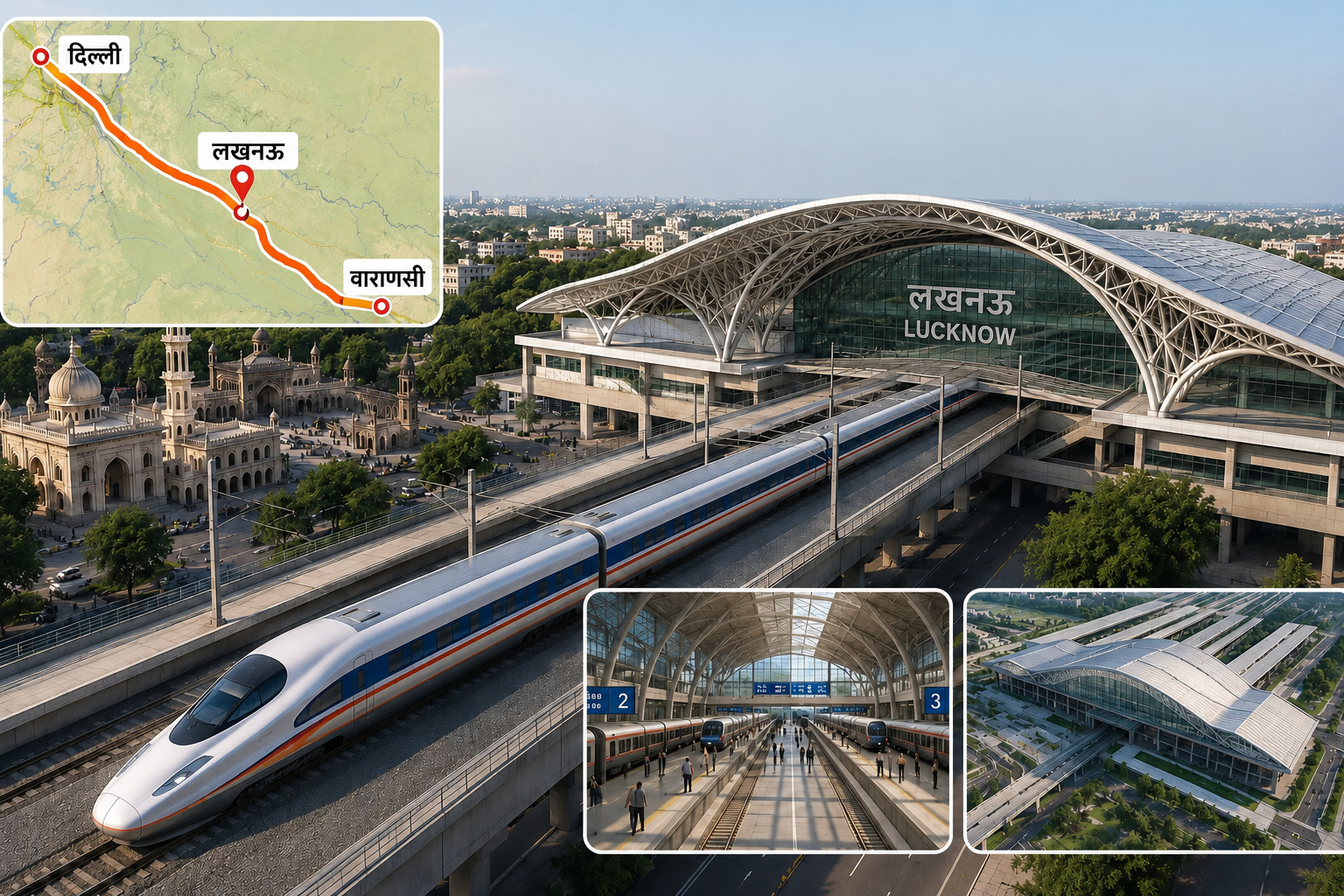
Lucknow: Uttar Pradesh’s capital is poised to become a key hub in India’s future high-speed rail network as deliberations over the location of the proposed bullet train station in Lucknow enter their final stage. The station will be part of the ambitious Delhi–Varanasi High-Speed Rail Corridor, one of the country’s most significant upcoming transportation projects.
According to sources, technical and administrative teams are evaluating four potential locations for the Lucknow station, with a final decision expected in the coming months. The shortlisted sites include the Chaudhary Charan Singh International Airport (Amausi area), the Sultanpur Road corridor, the Kanpur Road corridor, and areas connected to Shaheed Path.
Strategic Location Key to Future Expansion
Officials involved in the planning process are focusing on selecting a site that can accommodate future passenger growth while minimizing pressure on the city’s existing transportation infrastructure. The chosen location is expected to provide seamless integration with metro services, airport facilities, and major expressways.
Transport experts believe that locating the station near the airport could offer travelers a convenient interchange between air and rail transport. Alternatively, establishing the station on the city’s outskirts may reduce land acquisition challenges and provide greater scope for future expansion.
Part of an 800-Kilometre High-Speed Network
The proposed Delhi–Varanasi Bullet Train Corridor is expected to span more than 800 kilometres, connecting major cities including Delhi, Noida, Mathura, Agra, Kanpur, Lucknow, Prayagraj, and Varanasi.
The project follows the model of the ongoing Mumbai–Ahmedabad High-Speed Rail initiative and is considered one of the most ambitious infrastructure developments planned for northern India. The corridor is designed to significantly reduce travel times and enhance regional connectivity.

Delhi–Lucknow Journey Could Take Around Two Hours
High-speed trains on the route are expected to operate at speeds ranging from 320 to 350 kilometres per hour. Once operational, the corridor could reduce travel time between Delhi and Lucknow to approximately two hours, while substantially cutting journey times between Delhi and Varanasi.
The station location selection process is currently being undertaken by the National High Speed Rail Corporation Limited in coordination with the Ministry of Railways. Reports suggest that station zones for cities such as Mathura and Agra have already moved closer to finalization.
Lucknow Set to Emerge as a Multi-Modal Transport Hub
The project carries particular significance for Lucknow, which already benefits from an extensive transportation network, including the Lucknow Metro, multiple expressways, and an international airport.
With the addition of a bullet train station, the city could evolve into one of India’s most important multi-modal transport hubs, offering integrated connectivity across air, road, metro, and high-speed rail networks.
While the Delhi–Varanasi Bullet Train project remains in the planning and survey stage, the ongoing discussions over the Lucknow station underscore the city’s growing importance in India’s future transportation landscape and its role as a major gateway for northern India.